Brief Digital Marketing Plan Guide 2021 (3 Frameworks that could be used)
Digital marketing plans can be based around many frameworks to cover all the key areas that you are required to incorporate within the plan.
It is important that all digital online and offline channel assets that your company or even your own channel assets are covered within the plan if you are creating one for your own marketing efforts not associated with a company or organisation.
As without a plan you and or your company or organisation digital marketing assets may be utilized fully for you or your companies or organisations marketing efforts. This can be incorporated within your companies or organisations main marketing plan to an extent as these digital channels need to be acknowledged with your marketing plan especially in this day and age. Although, a separate more concentrated digital marketing plan for marketing can also be developed and utilized.
Three frameworks that can be utilized for a stand alone digital marketing plan. These frameworks can be the following ones noted within this blog post. There is also a quick summary of each of the below each framework framework as well as links to sources of further information on each.
Three frameworks that can be utilized for a stand alone digital marketing plan. These frameworks can be the following ones noted within this blog post. There is also a quick summary of each of the below each framework framework as well as links to sources of further information on each.
The three frameworks are as follows:
SOSTAC Digital Marketing Plan Framework

Source of above image : https://prsmith.org/wp-content/uploads/2020/05/SOSTAC-Guide.jpg
There is the SOSTAC Digital Marketing Plan Framework that was developed originally by Smith, P.R. during the 1990s although it has been updated over the years.
The model stages that begin with:
(1) S)ituation analysis stage is: 'where are we now?', followed by
(2) O)bjectives stage which is 'where do we want to be?', the next stage is
(3) S)trategy stage which is 'how do we get there?', followed by
(4) T)actics which is where you include and define the digital and communication tools that you use and the second last stage in the model is
(5) A)ction which includes the action plans, the change management as well as the project management.
(6) C)ontrol stage that takes into consideration the management of information such as the web analytics to see if both the strategic and tactical objectives are being achieved and if not how could you improve this to ensure better results.
This are two links to the sources including the original source of the 6 stages above are on Chaffey, D. website and a fuller summary:
Chaffey, D., 2020, SOSTAC marketing plan model, Source: https://www.davechaffey.com/digital-marketing-glossary/sostac-marketing-plan-model/
There are summary videos from Smith, PR (Paul) himself summarizing the the framework in 3 and 4 minutes on this page of his PR Smith Marketing website and certification exams you could consider completing also well as a 60 minute course on framework via Udemy here: https://prsmith.org/sostac/.
PR Smith has released many books on his framework. His latest book written on this framework was published and released last year (2020):
Smith, P.R. (2020) SOSTAC guide to your perfect digital marketing plan. PR Smith Marketing Success. Available on Amazon in Kindle and paperback formats here: https://www.amazon.co.uk/SOSTAC-Guide-Perfect-Digital-Marketing/dp/0956106862/ref=sr_1_1?crid=3DG3RARE2GUZS&dchild=1&keywords=sostac+guide+to+your+perfect+digital+marketing+plan&qid=1612654235&sprefix=SOSTAc%2Caps%2C165&sr=8-1.
Anicca's A10 Marketing Framework
There is the A10 Marketing Framework that was developed by Stanley, A. (2018, ANICCA, Introducing Anicca's A10 Digital Marketing Framework to develop your digital marketing strategy: https://anicca.co.uk/blog/introducing-aniccas-a10-digital-marketing-framework-to-develop-your-digital-marketing-strategy/) and Ross, S (2019, The State of Digital Marketing 2019: Introducing the A10 Framework: https://anicca.co.uk/blog/the-state-of-digital-marketing-2019-introducing-the-a10-framework/). There is full guide on this Framework here: https://anicca.co.uk/wp-content/uploads/2019/03/A10-Guide-Download-Web.pdf .

Source of the above image: https://anicca.co.uk/wp-content/webp-express/webp-images/uploads/2018/08/a10-diagram-600x501.jpg.webp
The 10 elements of the framework are as follows:
A1: Analysis
Taking into consideration your overall marketing objectives, the findings from your initial analysis, and your target audience for each segment; you will need to:
A3: Audience
A5: Awareness
You will need to use a range of POET (Paid, Owned, Earned & Technological) media channels to increase acquisition of traffic to your website, social communities or offline properties (including store visits, event attendance etc):
Maximize customer retention and loyalty, through proactive customer service and providing an excellent customer experience:
A10: Assessment
Full source of the above elements of the framework : Stanley, A. (2019, Source: https://anicca.co.uk/blog/introducing-aniccas-a10-digital-marketing-framework-to-develop-your-digital-marketing-strategy/). I've quickly summarised and bullet pointed the element from the original blog post from the Annicca's website. For the full summary on the website check the website link and the guide.
Propelrr's Digital Marketing Framework
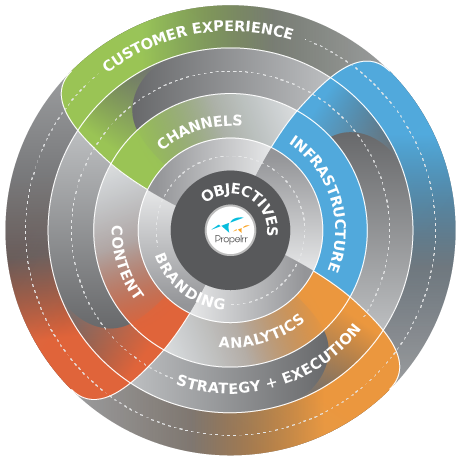
Source of the above image: https://propelrr.com/wp-content/uploads/2020/02/framework-1.png
There is the Propelrr's Digital Marketing Framework which was developed by Propelrr. There is a guide to the framework on the companies website here: https://propelrr.com/framework. There is a You Tube video by Francis Gary Viray, President and CEO of Propelrr explaining the framework and a blog post on their website: https://propelrr.com/blog/digital-marketing-framework-drives-success.
A quick summary of the framework is as follows:
(1) Objectives -
These objectives for the business can be formed using the FAVS's (Feasible, Attainable, Valuable & Straightforward) which Propelrr developed. It is a similar acronym to SMART (Specific, Measurable, Achievable, Realistic & Time-Bound). The SMART objectives model has been credited to Drucker, P. (1955) and Doran, G.T. (1991). I added this bit on SMART model / acronym as it is another model that generally used for setting objectives.
(2) Branding
There are 3 elements of brand within this stage:
(3) Infrastructure
The 6 elements of infrastructure within this stage:
(4) Analytics
This can be the following 6 type of analytics:
(5) Content
Content can be the following 6 types:
(6) Channels
4 types of channels:
(7) Strategy & Execution
Digital strategy statement that includes:
(8) Customer Experience
For the full blog from the website that the above information is from is Propelrr's (2019, How Propelrr's Digital marketing Framework Drives Online Success, source: https://propelrr.com/blog/digital-marketing-framework-drives-success).
These are only 3 digital marketing frameworks that can be utilized to plan your digital marketing efforts around. There are other frameworks that can be considered to help with outlining and planning your digital marketing activities. There's further information at the links that I've included and what is included is basically a summarisation of each of these frameworks and sources acknowledged.
I hope this blog and the links that I've included within this blog post helps you introduce yourself to these 3 frameworks and some of them have less information available online or a limited guide to them.
Good luck with developing your digital marketing plans potentially around one of the above frameworks or another framework that you would like to use for yourself or your own companies marketing / digital marketing efforts.
David Mc Donald, BSc (Hons)
Currently completing a MSc In Marketing
- SOSTAC Digital Marketing Plan Framework
- Anicca's A10 Digital Marketing Framework
- Propelrr's Digital Marketing Framework
SOSTAC Digital Marketing Plan Framework
Source of above image : https://prsmith.org/wp-content/uploads/2020/05/SOSTAC-Guide.jpg
There is the SOSTAC Digital Marketing Plan Framework that was developed originally by Smith, P.R. during the 1990s although it has been updated over the years.
The model stages that begin with:
(1) S)ituation analysis stage is: 'where are we now?', followed by
(2) O)bjectives stage which is 'where do we want to be?', the next stage is
(3) S)trategy stage which is 'how do we get there?', followed by
(4) T)actics which is where you include and define the digital and communication tools that you use and the second last stage in the model is
(5) A)ction which includes the action plans, the change management as well as the project management.
(6) C)ontrol stage that takes into consideration the management of information such as the web analytics to see if both the strategic and tactical objectives are being achieved and if not how could you improve this to ensure better results.
This are two links to the sources including the original source of the 6 stages above are on Chaffey, D. website and a fuller summary:
Chaffey, D., 2020, SOSTAC marketing plan model, Source: https://www.davechaffey.com/digital-marketing-glossary/sostac-marketing-plan-model/
There are summary videos from Smith, PR (Paul) himself summarizing the the framework in 3 and 4 minutes on this page of his PR Smith Marketing website and certification exams you could consider completing also well as a 60 minute course on framework via Udemy here: https://prsmith.org/sostac/.
PR Smith has released many books on his framework. His latest book written on this framework was published and released last year (2020):
Smith, P.R. (2020) SOSTAC guide to your perfect digital marketing plan. PR Smith Marketing Success. Available on Amazon in Kindle and paperback formats here: https://www.amazon.co.uk/SOSTAC-Guide-Perfect-Digital-Marketing/dp/0956106862/ref=sr_1_1?crid=3DG3RARE2GUZS&dchild=1&keywords=sostac+guide+to+your+perfect+digital+marketing+plan&qid=1612654235&sprefix=SOSTAc%2Caps%2C165&sr=8-1.
Anicca's A10 Marketing Framework
There is the A10 Marketing Framework that was developed by Stanley, A. (2018, ANICCA, Introducing Anicca's A10 Digital Marketing Framework to develop your digital marketing strategy: https://anicca.co.uk/blog/introducing-aniccas-a10-digital-marketing-framework-to-develop-your-digital-marketing-strategy/) and Ross, S (2019, The State of Digital Marketing 2019: Introducing the A10 Framework: https://anicca.co.uk/blog/the-state-of-digital-marketing-2019-introducing-the-a10-framework/). There is full guide on this Framework here: https://anicca.co.uk/wp-content/uploads/2019/03/A10-Guide-Download-Web.pdf .
Source of the above image: https://anicca.co.uk/wp-content/webp-express/webp-images/uploads/2018/08/a10-diagram-600x501.jpg.webp
The 10 elements of the framework are as follows:
A1: Analysis
- To audit and benchmark your website, social profiles (and other Owned media) to determine the level of traffic, trust signals, usability, customer engagement, conversions and customer service.
- To determine if your website performs technically and whether it is fit for your business purpose.
- How to analyse and benchmark your current marketing channels and activities as compared to your competitors.
- Utilizing the results of your analysis to correct any immediate issues or problems.
- Any long-term or more complex recommendations should be included in your aims and objectives.
Taking into consideration your overall marketing objectives, the findings from your initial analysis, and your target audience for each segment; you will need to:
- Determine the overall aims of your digital marketing and define the SMART (Specific, Measurable, Achievable & Realistic, Time-Bound) objectives for the Promotional Mix (Paid, Owned, Earned and Technology)
- Determine how each individual channel will contribute to the overall objectives at each stage of the funnel:
- Awareness
- Acquisition
- Action (conversion)
- Attention (and retention)
- Advocacy
- You will need to create measurable Key performance Indicators (KPI's) for each objective, which relates to the overall business and marketing objectives.
A3: Audience
- Use Analytics and various ad platforms to profile the characteristics of your existing customers and converters.
- Your audience analysis should be carried out for each category of products and services to identify different segments.
- Once you have data on the profiles of your ideal target audience, you can create personas to describe or represent each segment.
- The customer personas can be used by your team to know exactly who to target, when using different marketing channels, such as paid display, paid social, paid search and email.
A4: Assets
- Branding and integration with your corporate and offline marketing.
- Corporate and offline marketing strategy will give the context for your digital marketing plans.
- Create (or review) any documentation that outlines your brand guidelines and your “tone of voice”. These guides should be used to ensure consistency when new assets are created.
- Marketing is likely to be based on the content you develop, you will need to ensure that your website, blog, email and social media profiles are all performing properly and have the necessary functionality implemented for uploading and sharing content.
- Owned assets (for example your website and apps)
- The company's owned assets need to have the correct tracking and be populated with quality content that works for the user, Search Engine Optimization (SEO) purposes and to improve the credibility of your brand:
- You will need to develop and improve your website and other content assets across your own and third-party platforms.
- Check the technical aspects of your site and your other assets.
- You will also need to check or improve the quality of the content and design elements of your website and social profiles. Do you have the necessary trust signals, is there consistency across platforms or channels, are they suitable for your target audience(s).
- Social media platforms
- You will need to create or improve your social media profiles, including; account verification, consistency, imagery, enabling reviews etc, plus the creation of sub-pages for store locations or specific products and services etc.
- Set-up and use of the management dashboard for each platform (e.g. Facebook Business Manager). Use of account features such as account analytics, creation of tracking pixels, creation of audiences, use of creative hubs for sharing and storing images and videos
- Creation of initial and ongoing content on social platforms, including posts, articles, videos, stories etc
- Creation of content, promotional material and ads
- You will also need to formalise your processes (or use technology), for the creation, review, approval and use of creative assets.
- Work across teams to develop (or extend) a central bank of images, photos and messages, which can be used in future content creation, campaigns and ads (across all channels)
- Create new and ongoing assets for use in specific ad campaigns; including videos, images, lead generation forms, Canvas ads (for Facebook) etc.
- Create new and ongoing content (text and multi-media), promotional material and other supporting assets for specific campaigns (including content housed on your website)
- Technology toolset
- Select and implement your technology tool set for delivering, measuring and supporting your marketing activities.
- Include a mix of free and paid tools.
- To prepare for this needs to research, compare, demo and implement paid tools before using them in your marketing.
A5: Awareness
- You can do the following:
- A multi-channel techniques for increasing brand awareness across the digital marketing mix (POET).
- This will include the selection of channels, plus the planning, implementing and measuring of the campaigns you undertake.
- This is likely to include social media and PR activities (both Owned and Earned), as well as Paid channels like paid display and paid social.
- In addition to using channels and techniques to increase awareness, you may also need to invest in educating the audience or building trust and credibility
- You will need to find mechanisms to measure the level of brand awareness, including the amount of searches, mentions in social media and the press.
- Effective awareness campaigns should help increase in the size of your social communities, increase the amount of organic traffic to your site (via brand searches) and increase the amount of direct traffic to your site
- You may also need to use specialist tools or services to carryout surveys to determine brand recall and the impact of specific campaigns on the level of brand awareness.
A6: Acquisition
You will need to use a range of POET (Paid, Owned, Earned & Technological) media channels to increase acquisition of traffic to your website, social communities or offline properties (including store visits, event attendance etc):
- Targeting and optimizing your paid channels through search, display, social, eCommerce marketing.
- Managing owned channels using search engine optimisation (SEO), content marketing, social media, email and multimedia content (video, podcasts, webinars).
- Managing earned channels by encouraging positive online conversations about your brand by using social media, PR and influencer outreach etc. This may also include developing your community, fans and advocates, who will evangelise on your behalf.
- Developing Technical channels by exploiting current (and new) technologies/platforms that can impact your acquisition strategies.
- Inbound (pull) activities is where potential visitors are actively seeking out information or your product or service.
- Outbound (push) marketing is where you proactively push out information or ads to your target audience to encourage them to; visit your site, watch your video, read your content, join your online/social communities, or visit your store or outlet.
- A large part of the management of Acquisition techniques is testing and optimisation to ensure that you maximise the effectiveness of the campaigns.
- It is a requirement to use a mix of site and platform analytics/dashboards to determine the effectiveness of these campaigns and whether they result in actions and conversions.
- Understanding Actions and Conversions
- Actions are the interactions that users and customers have with your website, owned assets and other content or ads that you produce and distribute.
- Measure and improve the number of customer actions and the overall conversions generated from your assets or marketing activities.
- These conversions will have a direct impact on the amount of revenue generated by your business.
- Increasing your marketing performance and efficiency will result in an increase in conversion rates.
- This could help you achieve your target number of leads, sales (or other conversions), without needing to attract as much traffic.
- Increasing your conversion rates will normally help to achieve a lower cost per conversion, higher revenue, more profit for your business and a higher return on investment (ROI)
- It is normally easier to focus on improving the actions and conversions on the owned assets that you control.
- Although, you can also improve the effectiveness of your ads or content on third-party platforms; by the process of testing and optimisation.
- Improving actions and conversions on your website.
- You will need to use analytics on your website and possibly other specialist software to measure and understand user behaviour on your site:
- Macro-conversions – such as a sale or lead
- Micro-conversions – such as a newsletter sign-up
- Goals – measuring a specific action like visiting a contact page or completing a form by going to a thank you page
- Funnels – measuring the drop-off and user journey through the different stages of a process (such as a sales funnel)
- Events – these are on-page actions, such as; clicking a button call-to-action to submit a form, download a pdf or playing a video
- A full diagnostic or heuristic report can be developed by:
- Using a mix of tools and site reviews.
- The aim of this report is to understand user behaviour and their journeys on your site.
- The objective of the analysis is to determine any areas of user drop-off or parts of the site with a poor performance.
- Insight from the audit, the company could be able to develop strategies to improve your website. by improving calls to action, user journeys, user experience (UX) design, and to optimise conversion rates.
- Some changes can be made immediately, whereas others will require a more systematic testing programme, such as conversion rate optimisation (CRO) or A:B landing page testing.
- The creation of a working hypothesis that outlines what changes should be made to the site or user journey and the impact this would have on the performance on the website.
- Create alternative versions of the page or elements of the page that are currently performing poorly.
- You can use testing software to run A:B landing page tests, to see whether the new page outperforms the original (i.e. was the hypothesis correct).
- If the test was successful, then you can implement the new version of the page (or element of the page), which should result in an increase in engagement or conversion rate.
Maximize customer retention and loyalty, through proactive customer service and providing an excellent customer experience:
- This often falls to customer services, marketing or sales or a combination of these teams.
- These teams should work together, to develop ongoing customer communications to increase purchase frequency and customer lifetime value.
- Techniques can be used such as re-marketing, social, content, email strategies, outbound calls/visits etc.
- Specific Customer Relationship Management (CRM) or eCommerce technology to aid in the retention process or to prevent defections.
- Report on customer retention vs churn, cross- and up-selling, and lifetime value of customers.
- Managing customer service online and in public eye:
- In the past, poor customer service could often be dealt with behind closed doors.
- If, the customer is not satisfied, then social media as their preferred route to air complaints and issues (i.e. “naming and shaming” to embarrass a brand).
- It is essential to listen through social media channels for mentions of your brand.
- It is required that the company has staff, processes and policies in place to deal with online customer service. Although, this is only one channel that customers use to communicate with you, so you may need an integrated strategy:
- Good or well managed customer service can often generate good publicity, reviews and brand reputation, which can help advocacy.
- Poorly managed or the lack of management of customer complaints and concerns, is much more likely to negatively impact brand reputation and future sales.
- Many techniques used to encourage advocacy overlap with retention strategies.
- Your website, social media profiles and other owned assets.
- Third-party tools or adding functionality to your website.
- Advocacy often happens naturally via Earned media or third-party platforms. Although, incentive based incentive referrals or develop programs to recommend the company.
- In addition, there are other methods to proactively encourage advocacy such as from influencers, celebrities, or thought leaders to amplify your messages and brand.
A10: Assessment
- Website Analytics
- Ad platform and channels specific Analytics
- Conversion attribution
- Integration of data across multiple platforms
- Reporting and data visualization
Propelrr's Digital Marketing Framework
Source of the above image: https://propelrr.com/wp-content/uploads/2020/02/framework-1.png
There is the Propelrr's Digital Marketing Framework which was developed by Propelrr. There is a guide to the framework on the companies website here: https://propelrr.com/framework. There is a You Tube video by Francis Gary Viray, President and CEO of Propelrr explaining the framework and a blog post on their website: https://propelrr.com/blog/digital-marketing-framework-drives-success.
A quick summary of the framework is as follows:
(1) Objectives -
These objectives for the business can be formed using the FAVS's (Feasible, Attainable, Valuable & Straightforward) which Propelrr developed. It is a similar acronym to SMART (Specific, Measurable, Achievable, Realistic & Time-Bound). The SMART objectives model has been credited to Drucker, P. (1955) and Doran, G.T. (1991). I added this bit on SMART model / acronym as it is another model that generally used for setting objectives.
(2) Branding
There are 3 elements of brand within this stage:
- Voice
- Positioning and
- Personality.
(3) Infrastructure
The 6 elements of infrastructure within this stage:
- Security
- Compatibility
- Stability
- Scalability
- Performance / Speed
- People
(4) Analytics
This can be the following 6 type of analytics:
- Web
- Customer Relationship Management (CRM)
- Social Media
- Mobile App
- Business
- Ad
Content can be the following 6 types:
- Blog Posts
- Videos
- Infographics
- Clustered
- Listicles
- Interactive
(6) Channels
4 types of channels:
- Earned
- Paid
- Rented
- Owned
Digital strategy statement that includes:
- What you want to win?
- Where you want to compete?
- How you want to win?
(8) Customer Experience
- When customers feel good as a result of interacting or doing business with your brand, then you've got the makings of a loyal base and better growth for the brand.
For the full blog from the website that the above information is from is Propelrr's (2019, How Propelrr's Digital marketing Framework Drives Online Success, source: https://propelrr.com/blog/digital-marketing-framework-drives-success).
These are only 3 digital marketing frameworks that can be utilized to plan your digital marketing efforts around. There are other frameworks that can be considered to help with outlining and planning your digital marketing activities. There's further information at the links that I've included and what is included is basically a summarisation of each of these frameworks and sources acknowledged.
I hope this blog and the links that I've included within this blog post helps you introduce yourself to these 3 frameworks and some of them have less information available online or a limited guide to them.
Good luck with developing your digital marketing plans potentially around one of the above frameworks or another framework that you would like to use for yourself or your own companies marketing / digital marketing efforts.
David Mc Donald, BSc (Hons)
Currently completing a MSc In Marketing


Comments
Post a Comment
If, you have any comments on this specific blog post or possibly any suggestions on what you would like to see a post on next please comment below. Thank you in advance, David.